TL;DR
- A careful do-it-yourself check from the ground and inside your home points out problems early, before a small leak turns into a full roof replacement.
- Damage signs vary by roof type: flat roofs pool water, foam roofs blister and soften, tile roofs crack and expose underlayment.
- The 25% rule may let your insurance pay for a new roof if widespread, not just a patch.
- Asking the right questions and avoiding common mistakes with adjusters strengthens your claim.
- A licensed contractor’s written assessment (with photos) gives you the evidence you need to choose repair or replacement with confidence.
Why Is a Homeowner’s Roof Evaluation the First Step Toward Saving Money?
It catches small problems before they turn into expensive, large-scale damage, especially in Tucson’s punishing monsoon and UV climate. When you know what the roof looks like today, you avoid paying for unnecessary repairs or discovering too late that a full replacement could have been done under insurance. A fast, visual check from the ground and inside the attic gives you early warning signs, and coupling that with a professional inspection is the most reliable way to decide between
roof repair or
roof replacement.
In Southern Arizona, a roof that drips after a summer storm can rot decking and insulation quickly. If you catch the damage when it is still limited to a few tiles or a seam split, a same-day repair with a written warranty often solves the problem for a fraction of the cost of a new roof. That is why DC Roofing of Arizona offers free estimates and same-day response on every roof repair call. Getting an evaluation early means you pay for a patch, not a crisis.
How to Assess Roof Damage from the Ground, and When to Climb Up
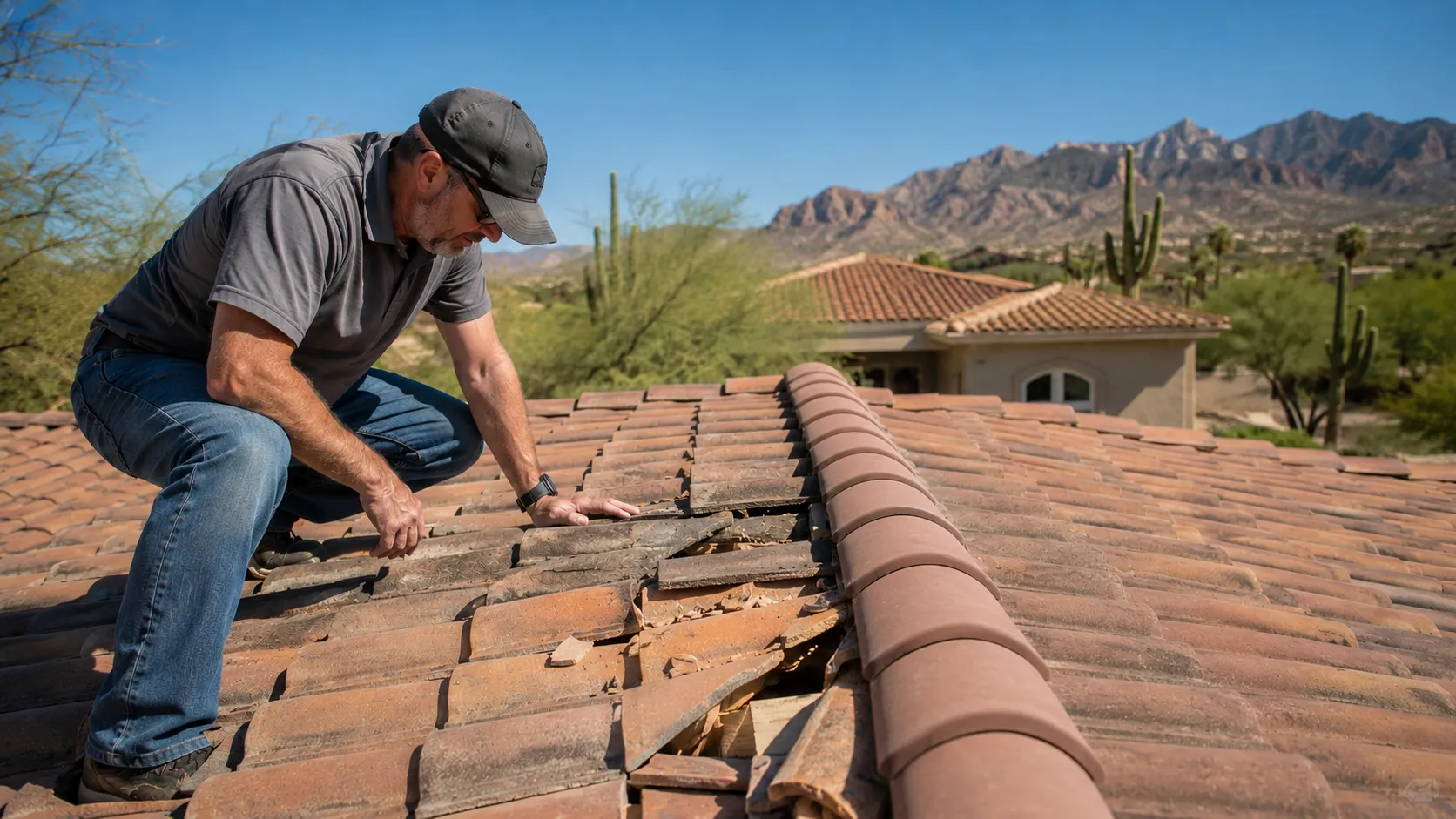
Start with a binocular scan from the ground, then climb only if the roof is dry and you have a safe ladder and a spotter, checking for missing shingles, cracked tiles, lifted flashing, and dented vents. You can spot most visible damage without ever leaving the ground. Walk around the house with a pair of binoculars and look at every roof plane, especially after monsoon wind events.
According to safety guidance, you should never walk on a wet or steep roof, and even on a dry day, someone should hold the ladder.(
https://www.amfam.com/resources/articles/at-home/how-to-check-your-roof-for-damage) Here is what to look for:
- Missing, curled, or cracked shingles: On sloped sections, a missing shingle exposes the underlayment to water. Granule loss leaves dark, bald spots that accelerate aging.
- Lifted or rusted flashing: Metal strips around chimneys, skylights, and vents can pull away from the surface. Even a small gap lets in monsoon-driven rain.
- Dented or displaced vents and caps: Hail or flying debris can knock plumbing boots and turbine vents loose. Check from the ground if any part looks out of place.
- Granules in gutters: An accumulation of colored grit at downspout outlets is a strong signal that the shingle surface is breaking down.
If you do climb a dry, low-slope roof, step only on the path indicated by the roof structure, wear soft-soled shoes, and never work near power lines. The moment you see any sign of sagging or feel a soft spot underfoot, get off the roof immediately and call a professional.
What Interior Warning Signs Should You Look For in Your Ceilings and Attic?
Water stains on ceilings, peeling paint, and daylight through roof boards tell you that damage is already advanced and needs quick action. Even if the roof surface looks fine from the outside, what is happening inside gives a more honest report on how well the roof is really performing.
Go into the attic with a flashlight on a bright day. Turn off the light so you can see any tiny pinpricks of sun. Those holes mean water can follow the same path during a storm. Next, check for:
- Water stains or damp insulation: A brown ring on the ceiling below the attic is a classic leak sign. In the attic itself, wet or compressed insulation indicates water has already pooled.
- Peeling paint or bubbling drywall: Humidity from a slow leak often shows up inside the home long before you see an actual drip.
- Musty smells: A persistent earthy odor in the attic is often tied to mold growth from persistent moisture.
- Sagging roof deck: If the plywood or OSB sheathing appears wavy or soft, the roof structure may be compromised and will not hold new fasteners well.
When interior clues appear, damage has usually spread beyond a simple surface patch. At that point, a professional roof inspection with photos and core samples is the best way to confirm whether it is repair time or replacement time.
How Does Roof Damage Look Different on Flat, Tile, and Foam Roofs?
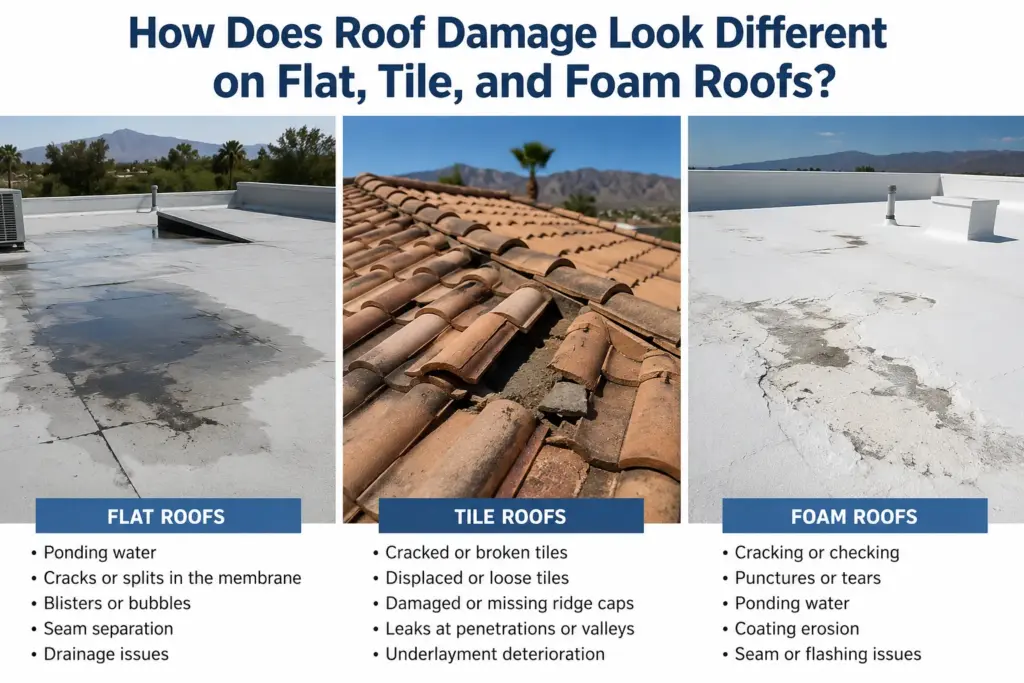
Each roof type shows unique warning signs: flat roofs exhibit ponding water and seam splits, foam roofs develop bubbles and soft spots, and tile roofs suffer cracked tiles and underlayment exposure. Because Tucson homes carry all three styles, knowing what to look for on your specific roof avoids misdiagnosis.
For
flat roofs (modified bitumen, TPO, EPDM), the biggest red flag is standing water that stays more than 48 hours after rain. Ponding accelerates membrane degradation and can cause seams to separate. Inspect the seams and flashing for any lifting or wrinkling. If you see dark, alligator-textured patches on a modified bitumen roof, the surface is drying out and cracking. DC Roofing of Arizona’s flat roof repair team often finds that what looks like a minor blister on the surface hides moisture trapped below.
Foam roofs need a close look for bubbles ranging in size from a quarter to a dinner plate. A bubble is a pocket where the foam has delaminated from the substrate, often caused by water intrusion. Soft spots feel spongy underfoot and indicate the foam itself is saturated. The coating layer may show chalking or powdery residue when you run your hand across it, meaning the UV protection is gone. The foam roofing diagnosis process includes probing soft areas to see whether the damage is confined to the top coat or extends into the foam layer.
Tile roofs have the visible, brittle surface you can assess from the ground using binoculars. Look for shattered or sliding tiles, especially along the eaves and hips. Cracked tiles allow monsoon rain straight onto the underlayment, which is the real waterproofing layer. If the underlayment is exposed, it degrades quickly under Arizona sun. For any tile that is out of place, tile roof repair that restores the underlayment and matches the tile is essential before a small shift turns into a whole-section replacement.
No matter the roof type, surface damage you can see often has a hidden twin underneath. That is why a professional assessment that checks the substrate and insulation is so valuable.
Repair vs. Replacement: A Side-by-Side Comparison
Making the right call depends on how much area is damaged, the roof’s age, the condition of the underlying deck, and what your budget can absorb over the next five years. The chart below lines up the factors side by side, drawing from inspection standards and Tucson’s specific wear patterns.(
https://www.nrcia.org/roof-inspection-insurance-claim/)
| Decision Factor |
Roof Repair |
Roof Replacement |
| Extent of damage |
Isolated to less than 20% of the roof surface; single seam, flashing, or a few tiles. |
Widespread cracking, blistering, or saturated substrate across more than 25% of the roof. |
| Roof age |
Less than 10 years old and structure is sound. |
Over 15 years old with multiple prior repairs or general material fatigue. |
| Deck condition |
Sheathing is dry and solid; no rot or sagging. |
Decking feels soft, shows delamination, or fails a core sample. |
| Cost over 5 years |
Lower upfront spend, but recurring patches can add up if more sections fail each season. |
Higher one-time cost, but eliminates the cycle of annual emergency calls. |
| Energy impact |
A quality repair, especially on a foam or coated flat roof, preserves existing insulating value. |
New cool-roof systems can cut cooling costs 15, 30% and meet Arizona Title 24 requirements. |
| Typical added lifespan |
May extend life by 3, 7 years depending on the system. |
20, 50+ years with current materials, resetting the clock. |
| Insurance role |
Often fully covered if damage is sudden and accidental. |
May be fully covered if damage exceeds the 25% threshold or if the adjuster deems the roof unrepairable. |
When you suspect the damage might tip the scale toward replacement, DC Roofing of Arizona provides a free roof replacement estimate after a thorough inspection, so you can compare real numbers instead of guessing.
What Is the 25% Rule for Roofing, and How Does It Affect Your Insurance Claim?
The 25% rule is an insurance guideline that if more than 25% of your roof surface is damaged, the insurer may pay for the entire roof to be replaced rather than just repairing individual sections. It is a claims adjustment standard, not a building code, but it often determines whether you get a patch or a new roof.
Insurers consider the total roof square footage and calculate what percentage shows covered damage from a single event, such as a hailstorm. If that number crosses 25%, many policies trigger a full replacement payout, minus your deductible. However, the adjuster’s measurement and the way damage is classified matter a great deal. That is why having a formal, photo-documented inspection report from a licensed contractor can help your claim.(
https://www.kin.com/blog/roof-damage-insurance-claim/)
If your roof is older, the 25% rule becomes even more important. Multiple small patches over time may leave you with a patchwork that no longer appears uniform or performs consistently. A documented report that shows the combined percentage of storm-related and age-related failure can show the adjuster that continual repairs are no longer a viable solution, nudging the decision toward replacement.
What Should You Ask When Getting a Roof Estimate?
Ask whether the contractor is licensed and insured, if the estimate includes a written inspection report and photos, what warranty is provided, and exactly which materials will be installed. A low price without these details often means corners that will cost you later.
A professional roof estimate in Southern Arizona should answer every one of these questions:
- Are you licensed, bonded, and insured? Ask for the Arizona ROC number and verify it. DC Roofing of Arizona holds ROC #328733, carries full insurance, and provides that information openly.
- Does the estimate include a written inspection report with photos? An estimate that is just a number on a line is a gamble. A real report shows the damaged areas, the proposed fix, and the material specifications.(https://www.nrcia.org/roof-damage-assessment-report/)
- What is the exact warranty on materials and workmanship? “Written warranty” is what you want to hear. Ask for the document before work starts so you know what is covered and for how long.
- What materials and installation method will be used? For a TPO roof, ask the membrane thickness; for foam, ask the density and coating thickness; for tile, ask the underlayment type. Every detail affects how long the roof performs in Tucson’s climate.
- What is the timeline, and how will you protect my property? A crew should explain daily cleanup, how they handle monsoon-season schedule changes, and what happens if hidden damage is found.
A roof inspection that comes with a thorough estimate is your best tool for comparing offers on a level playing field. Without it, two numbers that look similar can represent wildly different scopes of work.
What Should You Avoid Saying to Your Insurance Adjuster?
Stick to observable facts, avoid speculating about the cause or using words like “old” or “worn out,” and never admit any lack of maintenance. What you say can directly influence whether your claim is approved or denied.
Insurance adjusters are trained to look for reasons to categorize damage as gradual wear and tear, which is typically excluded from standard policies. A simple “The roof was getting old” may lead the adjuster to attribute the damage to age, not the storm event you are filing for. Instead, describe what you saw: “After the August 12th monsoon, I noticed water stains in the hallway and found cracked tiles on the south side.” Let the photos and the professional inspection report speak for themselves.(
https://www.westfieldinsurance.com/about-us/articles/roof-insurance-explained)
Other phrases to avoid:
- “I think it was that way for a while.” This invites a denial based on lack of maintenance.
- “Just a small leak.” Downplaying the severity can result in a smaller settlement that fails to cover the full repair.
- “I haven’t been up there since last year.” The adjuster may infer neglect, even if the roof was fine.
The safest approach is to provide the adjuster with a written, date-stamped report from a licensed roofer that includes photos of the damage, the substrate condition, and a measured percentage of affected area. That factual record gives the adjuster an objective basis to work from and protects you from accidental misspeak.
When Should You Call a Tucson Roofing Professional for a Real Assessment?
When interior signs appear, after any major storm, or if your roof is over 10 years old, a licensed contractor’s written report gives you a defensible repair-or-replace recommendation. Your own visual check is an excellent first step, but it cannot see what is happening inside the roof system.
A professional assessment goes beneath the surface. Technicians probe foam roofs for hidden moisture, check the tightness of TPO and EPDM heat-welded seams, and lift a tile to inspect the underlayment. They produce a report with photos, measurements, and a clear scope of recommended work. This document becomes your blueprint for repairs today and a reference point for any insurance claim or future real estate transaction.(
https://inspector-roofing.com/evidence-based-roof-inspections/)
For Tucson homeowners, the best times to schedule that assessment are right before the monsoon season (May/June) and again in the fall after the storms have passed. That two-visit rhythm catches winter wind damage and summer deluge issues on the schedule that prevents small problems from growing. If you ever face a sudden leak during a storm, DC Roofing of Arizona provides emergency roofing with a same-day response. Once the temporary fix is in place, we follow up with a full written evaluation so you know whether that one patch is enough or whether a more complete solution is needed.
Making the repair-or-replace decision without a professional report is a risk that no Tucson homeowner should take. With a free estimate and an inspection you can trust, you save money, protect your property, and avoid the wrong call.
Frequently Asked Questions
How often should I schedule a professional roof inspection in Southern Arizona?
Twice a year, once in late spring before monsoon season and again in late fall after the storms have passed. That schedule lets you catch winter wind damage and summer water intrusion before they compound. Many Tucson homeowners find that a spring inspection pays for itself by preventing emergency calls in July and August.
What should I do in the first 15 minutes after discovering a roof leak?
First, place a bucket under the drip and move furniture and electronics away from the wet area. If the ceiling is bulging, carefully puncture the paint bubble with a screwdriver to drain the water in a controlled way, which can prevent a larger ceiling collapse. Then, call a licensed roofing contractor for an emergency tarp or seal so the water stops entering the home, and document everything with timestamped photos for your insurance.
Can a roof coating extend the life of my flat roof enough to delay replacement?
Yes, a quality silicone or elastomeric roof coating can add 15 to 25 years of service to a flat roof that is structurally sound but showing surface wear. The coating seals small cracks, reflects UV rays, and stands up to ponding water. It delays replacement for many Tucson flat roofs, provided the substrate and drainage are checked first so the coating bonds to a solid surface.
Does DC Roofing of Arizona handle insurance claims directly?
We do not become a party to your claim, but we provide everything you need to submit one successfully. Our team documents damage with photos, creates a detailed inspection report, and can be present during the adjuster’s walkthrough to point out the exact areas of concern. Many homeowners use our report as the primary evidence for their claim.
Is it safe to walk on a tile roof to inspect it myself?
No, walking on a tile roof without professional training frequently cracks tiles that were not previously broken, creating new leaks. Tile surfaces are also slick when dusty or wet, increasing the risk of a fall. A professional inspection uses walk boards and harness systems that protect both the roof and the worker, so you get an accurate assessment without adding damage.